I Need to Say “Thank You!”

Dear City of Asheville Mayor Esther Manheimer –

Times of crisis reveal character and leadership. Your resilience and unwavering commitment have been truly inspiring!

You have done an outstanding, heroic job of coordinating the efforts of the City of Asheville, NC, with federal, state, county, and faith-based agencies responding to the havoc, chaos, and damage caused by Hurricane Helene.

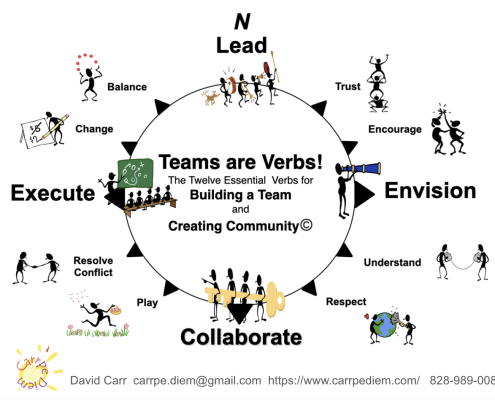
Thank you! Your tireless work and efforts have built trust, created hope, and instilled pride in continuing to rebuild our community.

I thank your family, too. They are essential to your support in carrying out this mission.

I have your back and will be a follower in the next crisis you lead!

Carrpe Diem!

David Carr

What Is A Typical Day Like Without Power, Internet, or Water?

We are coming up on day 14 without power, internet, and water. Someone recently asked, “What is a typical day like without power, internet, or water?”

My day begins in the first sunlight.

When I get out of bed, I “wash” my hands with hand sanitizer and brush my teeth using water from a bottle. Then, I put all the lights that run on solar in the window to begin recharging.

I go downstairs, open the garage door, turn on the gas grill, start boiling water for coffee, and wash dishes. I plug my coffee bean grinder into a generator and grind beans to make French Press coffee.

While the water is heating, I take Dash (our Jackweenie) for a walk. By the time we return, the water for the coffee is boiling. While the coffee is seeping into the French Press, I clean up and straighten up the tables with food, tableware, and cleaning materials. Trash gets emptied. Water gets checked. There are three types of water on hand. Water for drinking. Potable water to be boiled for cooking and washing dishes. Creek water for flushing toilets. I determine which of these water sources need to be replenished.

When the water for washing dishes has boiled, I carefully bring it upstairs, prepare a tub for washing dishes, and then a tub for rinsing and sanitizing dishes.

I try to tune into the 10 AM Buncombe County Government briefing for updates and information from on-the-ground subject matter experts in water, police, healthcare, and others.

I make time to create the “to-do” list for the day. Ice? Water? What is the food for the day, including seeing who will be preparing dinner that evening? Exercise? (Stretching is essential!) Shower and laundry (which requires driving 14 miles to my cousin’s home who has water, power, and internet.)? Checking on neighbors for water and ice? Volunteering? Helping neighbors? Check on Carrpe Diem consulting work? Email? Read? Top off car gas tank? Cash (many places take cash only and will not give back change.)?

The day begins to wind down around 4 PM. Dash gets another walk. It will get dark by 7:30 PM. Since we are the hub for the “community kitchen” where neighbors gather for dinner, a table needs to be brought out to serve dinner. The fire pit needs to be started as the sun goes down and it gets chilly! A flip chart is brought out for people to share announcements, make requests, or see who will fix the next day’s dinner. The generator gets turned on so people can plug in devices for recharging.

Dinner is served around 6 PM. People may linger around the fire pit and talk, but most turn in before 9 PM. I’m in bed shortly after.

Are You Ready For Disaster?

This disaster in Western North Carolina is beyond imagination. No movie director could top the scenes in and around us. The pictures I could share of downed trees, power lines, and water runoff are nothing compared to what you see on the national news. The destruction in Biltmore Village is heartbreaking. The communities of Swannanoa, Black Mountain, and Montreat are a mess. Chimney Rock, which we pass through several times a year to go to a cabin at Lake Lure, has been wiped out, as well as parts of ST RT 74. Instead of birds, we hear chainsaws and generators.

I would ask you to pause, look around you, and consider what you are grateful for. What do you take for granted? How well are you connected with your neighbors? Do you check in on them? Do they check in on you?

Put yourself in a position of “What if this happened to me?” Do you have the basic supplies, including drinking water, ready-to-eat meals, flashlights, a transistor radio, hand sanitizer, a first aid kit, and other essentials?

Here is the greatest gift of this disaster: our neighbors! We began gathering the last Friday of each month 15 years ago to share food, sit around a fire pit, and connect. We have been there for one another during this disaster, clearing downed trees, removing debris, rerouting water, sharing, comforting, laughing, and crying. Neighbors help us to endure this disaster. They help turn a problem into an inconvenience we are enduring together.

2024 VP Nominee, Tim Walz, Can Call Me Weird!

Tim Walz can call me weird, but I appreciate this serious crisis I am experiencing in Asheville, NC.

“You never want a serious crisis to go to waste!” – Rahm Emanuel

Reminded: I am a creature of habit. After seven days without power, I still walk into a room and reach for a light switch! Take a breath and be present!

Resourcefulness: Many times, when facilitating a group or team doing an exercise or completing an initiative, I will ask, “Are you using all your resources? What are your resources? What questions need to be asked? What are the implications of what you are doing?” This crisis has made me a participant who must answer these questions to move forward. Take a breath and continue to be resourceful!

Creativity: Creativity gets sparked when seeking ways forward. The human spirit shows ingenuity and sparks many “What ifs.” Take a breath and be creative!

Kindness: The table has turned in this crisis. I am seeing far more kindness and empathy and less incivility! Yes, some motorists still don’t follow protocol at 4-way stops, but the sharing, the smiles, the “How are you doing?” and the phone calls and texts from people I haven’t heard from checking in on us have brought smiles. Take a breath and be kind!

Patience: This crisis has tested patience. I’ve been waiting in line to get gas for the car, waiting for water to boil to make coffee, listening to someone ramble on and on without taking a breath, waiting for power to come back on! (It’s still off), and waiting for water to come back on (this could take weeks!) Take a breath and be patient!

Need: There is so much I want and so little I need. So many people around me need things like a warm bed to sleep in, food to eat, water for drinking and bathing, medications filled, and just a hug! Take a breath and share privileges with those in need.

Community: We live in a nation that promotes individualism. But it’s a community that allows for survival and thriving. I recognize I need “me” time and aloneness, but I need others, especially with whom I can be vulnerable. I need a community that supports rather than fixes me, respects me and my differences, and shares their strengths and competencies where I am weak and incompetent. Take a breath and seek, build, and grow a community!

When Did You Become An Adult?

One of my favorite questions to ask coaching clients is, “When did you become an adult?”

Louise Aronson, Elderhood: Redefining Aging, Transforming Medicine, Reimagining Life, writes if we live a full life, we will experience childhood, adulthood, and elderhood.

Adulthood is that expansive gap between childhood and elderhood.

Defining childhood is hard. Is it biological from birth to puberty through adolescence? Is it a social construct? Is it a lack of power that adults possess? After all, Santa Claus is an adult, and he’s watching you!

Boundaries from childhood to adulthood are blurred. Some cultures have rites of passage where a young person becomes an adult with more responsibilities and privileges. Turning sixteen in the United States and getting a driver’s license is a stepping stone to adulthood. At eighteen, you get to vote and join the military. At twenty-one, you can consume alcohol legally.

What does it mean to become an adult? The Oxford Dictionary says that an adult is a state or condition of being fully grown or mature. That leads to questions of what is fully grown. What is fully mature? Some say we spend our lives “becoming adults” and perhaps never reach that stage. Others say “the child” remains in us and is shown when our childhood wound gets triggered.

Do you become an adult when you recognize what you can and cannot control?

Do you become an adult when you accept yourself just as you are with all your warts, scars, and imperfections?

Do you become an adult when you stop comparing yourself to others and stop caring and worrying about what others think and say about you?

Do you become an adult when you become mindful and recognize what you consume?

Do you become an adult when you recognize the communities you are a part of and how they impact your life positively or negatively?

Do you become an adult when you focus on needs, wants, and the discipline to handle them?

Becoming an adult was when I had to get serious about the rest of my life. It occurred after my divorce. Counseling challenged me to consider who I was, what I was, and how I wanted to be experienced by others. For the first time, I had to look at myself in the mirror and ask, What’s my purpose in life? What are the values I want to hold myself accountable to? What habits were serving me well versus what habits not serving me well? I began to think about the bigger picture and the future. It was more than being financially independent, being in a committed relationship, and becoming a parent.

I don’t believe there is any one single event, but I do find a series of connected events that lead to this transition from child to adult.

When I ask this question, women tend to reveal they became adults earlier than men. This may be because the female brain develops earlier than the male, and female genetics are more potent.

Pretty much at every age, women seem to survive better than men. In extremely old age, the gap between the sexes becomes a glaring one.  – Steven Austad, Chair of Biology, University of Alabama

So, when did you become an adult?

What Would Break A Friendship For You?

The Republican Party is in chaos. There are two very different brands of Republicans. There is the Liz Cheney and Adam Kinzinger Republican brand who put the United States over party. They support democracy, not autocracy. I know Liz and Adams’s values. I trust Liz and Adam. I can agree to disagree with Liz and Adam Republicans.

Then there is the MAGA Republican brand led by: a misogynist with a narcissistic personality disorder; who has told over 30,000 fact-checked lies during his presidency; who supports White Christian Nationalism (which is not what our forefathers had in mind when they wrote the Declaration of Independence and the Constitution); of whom 21 of his former White House staff will not vote for him including former Chief of Staff retired Marine General John Kelly – is a different brand. And those who support MAGA and its leader scare the joy, the hope, the trust out of me.

I can no longer tolerate the line, “Just because we oppose each other politically doesn’t mean we can’t be friends.”

“Show me your friends, and I’ll show you your future. The people you’re hanging out with today are shaping the person you will become tomorrow.” – Craig Groeschel

If you believe and support the Project 2025 playbook, which promotes autocracy over democracy, is the way to govern the United States, that is a friendship breaker.

If you believe a government, judicial system, or a man can tell a woman what she can and cannot do with her body, that is a friendship breaker.

If you embrace Christian Nationalism, which excludes about 30% of the population or over 100,000,000 people, that is a friendship breaker.

If you call yourself pro-life but are only pro-birth because you don’t care about people experiencing poverty, the imprisoned, people experiencing homelessness, the immigrant, the uninsured, or the lack of legislation to create gun safety, that is a friendship breaker.

If you support gerrymandering, unfair voting, and denial of a peaceful transfer of power, that is a friendship breaker.

If you don’t believe LGBTQ+ and BIPOC should be treated fairly and with equity, that is a friendship breaker.

If you continue to promote and contribute to the unhealthy ways we treat planet Earth, that is a friendship breaker.

If you believe your opinion and conspiracies are more important than facts and evidence, that is a friendship breaker.

If you would like to have a challenging conversation about these “friendship breakers” that include listening to each other to understand and sharing fact/evidence-based perspectives rather than opinion and conspiracy, let’s find a time and place to meet face-to-face.

What Are You Voting For November 2024?

I’ve never worn a presidential campaign button. I have never donated to a presidential candidate campaign. I’m doing both now as an older, white, heterosexual, Christian, able-bodied, economically stable, registered independent, privileged male who not only supports and will vote for Kamala Harris but will also be voting for:
– democracy over Project 2025 and autocracy;
– leadership that is trustworthy, compassionate, stable, and hope-enhancing;
– facts and evidence over ignorance and conspiracy;
– continuation to evolve rather than devolve;
– kindness over heartlessness and stop being weird;
– commUNITY over inDIVDualism;
– ending Citizen’s United and PAC influence on politicians;
– a balance of power;
– fair and equal access to voting;
– elimination of gerrymandering;
– peaceful transfer of power;
– term limits for all politicians and court judges, including SCOTUS
– a fair and just criminal justice system;
– a woman’s right to choose what happens to her body;
– gun safety;
– separation of church and state rather than Christian Nationalism;
– equity for BIPOC and LGBTQ+;
– affordable healthcare as a right and not a privilege;
– treating Earth and climate with care and respect;
– global alliances with countries that support democracy like NATO members;
– fair, responsible, accountable taxation for individuals and corporations;
– world-class education for every child with no book bans and increased emphasis on the untaught history of this country, good pay for teachers.

What will you be voting for in November 2024?

Are We Able To Have Trustworthy Elections?

I attended the Braver Angel WNC Town Hall, a significant event that was based on the Braver Angels Trustworthy Elections Report, a comprehensive and credible resource on Restoring Trust in Our Elections.

The Town Hall began with an overview of the report. Then, we broke into seven small groups, each discussing one of the seven election topics.

1. Fair and Equal Access to Voting

2. Verifiable Voter Identity and Eligibility

3. Transparency and Accountability

4. Redistricting – Gerrymandering

5. Confidence in Vote Counting

6. Safety and Security in the Elections Process

7. Peaceful Transfer of Power

At my table, we discussed the Peaceful Transfer of Power. Conservatives, liberals, and independents agreed with the three solutions offered: 

– All candidates and citizens are encouraged to sign Team Democracy’s Safe and Fair Elections Pledge.

– Political parties should include a plank in their platforms that asks their supporters to take and honor the pledge.

– No state legislature or elected or appointed (non-judicial) official should be able to overturn election results. In 2023, the Supreme Court affirmed this position, rejecting the “independent state legislature” theory (Moore v. Harper).

We had concerns about media bias and coverage (or lack thereof). For factual news, it was suggested that we go to news sources 1440.com and Ground News.

Each table shared a summary of their discussion with the whole Town Hall and took questions.

We then decided which election topic Braver Angels should focus on in the coming year.

You can see the results in the photo below.

Joining Braver Angels is an opportunity to be part of healthy, safe conversations on difficult topics. I encourage you to consider becoming a member and contributing to our mission.

What Is Fair?

An electrician recently charged me $1,200 to rewire our kitchen for remodeling. He and his partner were there for 6 hours. The cost of supplies was over $100. I thought his bill was expensive.

Then, I heard back from a client on a proposal for leadership development, who told me my fee was too high.

When I explained why my fee was what it was, I realized the electrician’s fee was also fair.

I wasn’t paying for the electrician and his partner’s time; I was paying for their experience and knowledge.

I paid $1,200 because he and his partner had the expertise, skills, and tools to do what I couldn’t.

Now I realize $1,200 was fair.

It takes slow critical thinking to come to a better understanding and better outcomes. As a result, I feel true joy!

The Curse of, “I Didn’t Think About That!”

How often have you said to yourself and others, “I didn’t think about that.” or “That didn’t cross my mind.” or “I hadn’t considered that.”?

Why did you say that? Why did you think that? Were you guilty of “fast thinking”? According to Daniel Kahneman, Thinking Fast and Slow, we spend over 90% of our thinking … fast. We don’t like to think slow because it takes more energy. It takes energy to be curious. Our comfort zone is laziness, compliance, and addiction. It’s so much easier to go to the familiar and pleasurable. As a result, “We don’t see things as they are, we see them as we are.” – Anais Nin

Asking questions is an art and a fundamental art of leadership. Questions are more important than answers. Questions reveal what we are thinking. Answers reveal what we know and our judgment. Why don’t we ask more questions to seek to understand rather than to reply? Why do we intimidate people who don’t speak our language, share our beliefs, or look like us?

Adam Grant, Think Again: The Power of What You Don’t Know writes we need to learn to rethink and unlearn.

“In our daily lives, too many of us favor the comfort of conviction over the discomfort of doubt. We listen to opinions that make us feel good instead of ideas that make us think hard. We see disagreement as a threat to our egos rather than an opportunity to learn. We surround ourselves with people who agree with our conclusions when we should be gravitating toward those who challenge our thought process. The result is that our beliefs get brittle long before our bones. Intelligence is no cure, and it can even be a curse: there’s evidence that good thinking can make us worse at rethinking. The brighter we are, the blinder to our limitations we can become.”

Have you read Project 2025? It’s over 900 pages on moving the United States from democracy to autocracy.

Project 2025 is a roadmap for big-government authoritarianism. For example, The Department of Education and the Department of Commerce would be eliminated. Most  U.S. Government departments would morph into service to create a Christian Nationalist state in which any non-Christian (or non-conservative-Christian) is rendered a second-class citizen. (Forward)

Project 2025 raises a lot of questions for me.

What is religious liberty? What does Christian Nationalism mean? How does Christian Nationalism threaten religious freedom? What does Christian Nationalism mean to someone Jewish? Someone who is Muslim?

How does Christian Nationalism distort the teachings of Christ? Wasn’t Christ on the side of the marginalized and the oppressed? Does Christian Nationalism side with the marginalized and the least of us? Does Christian Nationalism center on the Gospel of love?

Does Christian Nationalism promote democracy? Is Christian Nationalism patriotic? What is the connection between Christian Nationalism and White supremacy?

How are patriotism and faith similar? Don’t they each have to be freely chosen?

Why does Christian Nationalism give credence to violence and divisiveness?

Why does Christian Nationalism seek to reverse advances in women’s rights and LGBTQ+?

Why does Christian Nationalism perpetuate a caste system that seeks rights for those in power?

Why did the Constitution’s founders and signers write Article VI: “No religious test shall ever be required as a qualification to any office or public trust under the United States.”?

Why did our founding fathers write in the Bill of Rights: “Congress shall make no law respecting an establishment of religion or prohibiting the free exercise thereof.”

Does the recently enacted law in Louisiana requiring the display of the Ten Commandments in every school classroom violate the Bill of Rights? Does the recent mandate in Oklahoma requiring the teaching of the Bible in the classroom violate the Bill of Rights?

For faith to thrive, shouldn’t it be chosen freely and not demanded by a governmental authority?

Where might you go to get out of your comfort zone, relearn, and unlearn? Here are some suggestions:

For daily news, check out The League of Women Voters to see charts on how reliable your news source is and to understand media bias.

Consider reading Ground News. It shows multiple perspectives compared to your regular go-to sources. I also suggest connecting with 1440 News. They focus on facts and not opinions. According to Snopes, 1440 News is who they say they are and is in the middle of the media bias chart.

Podcasts I find that challenge my rethinking, relearning, and unlearning:

Reflector“Reflector is a documentary-style podcast that tells stories about the strange experiences of being human. Our stories focus on how beliefs shape our world, the context behind our society’s messy debates, and how deeply listening to one another can reveal a sense of shared humanity. We aim to spark wonder, unveil complexity, and ignite curiosity.”

Hidden Brain“Nowhere is this journey of exploration more profound than in the discoveries we can make about ourselves. Our inner worlds are so much with us, so familiar to us, that many of us have lost the ability to marvel at our minds. Yet, there is no form of exploration more exhilarating. Every episode of Hidden Brain aims to help people get to know themselves better and think of their inner worlds with less judgment and more curiosity.”

Search Engine“Search Engine is a show where we try to answer the kinds of questions that you might normally ask the internet—questions that might be too potentially dumb-sounding, too personal, or too hard to answer otherwise.”

Code Switch“We’re a multiracial, multigenerational group of journalists who explore how race affects every part of society — from politics and pop culture to history, food, and everything in between.”

Right, Left, and Center” Left, Right & Center” serves as a civilized yet provocative antidote to the self-contained opinion bubbles of political debate. It first debuted in 1996 and has grown into a premier political discussion destination for listeners.”

Throughline“Throughline is a time machine. Throughline travels beyond the headlines of each episode to answer the question, “How did we get here?” We use sound and stories to bring history to life and put you in the middle. From ancient civilizations to forgotten figures, we take you directly to the moments that shaped our world.”

Besides the two books I mentioned earlier, consider these books:

Democracy Awakening, by Heather Cox Richardson. Heather Cox Richardson is a history professor at Boston College as well as the author of this book. She writes a daily newsletter, Letters from an American, on the history behind today’s politics and has taught me more about American history than any high school or college history class I took. Her latest book is full of history lessons.

How To Know a Person by David Brooks. “There is one skill that lies at the heart of any healthy person, family, school, community organization, or society: the ability to see someone else deeply and make them feel seen—to accurately know another person, to let them feel valued, heard, and understood.”

Factfulness by Hans Rosling, Ola Rosling, and Anna Rosling. “Rönnlund offers readers a wealth of statistics and facts that reveal the world far better than it was just a few generations ago. But, more than that, author Hans Rosling also offers readers a way to revise their thinking and fight against our instinct to focus on the bad and lose sight of the good.”

The Art of Gathering by Priya Parker. “Gatherings in our lives – from business meetings to dinner parties – are lackluster, routine, and lacking in purpose. Parker sets out a bold new approach to gathering that focuses on distinctiveness, purpose, and real human connection and shows how simple steps can invigorate any gathering of people.” I wish this book had been published 25 years ago!

The Gifts of Imperfection by Brene Brown. “Brown offers ten guideposts for our minds, hearts, and spirits to explore and cultivate the courage, compassion, and connection to wake up in the morning and think, No matter what gets done and how much is left undone, I am enough, and to go to bed at night thinking, Yes, I am sometimes afraid, but I am also brave. And, yes, I am imperfect and vulnerable, but that doesn’t change the truth that I am worthy of love and belonging.” I own and have read most of Brown’s books. This is still my favorite.

Dopamine Nation by Anne Lembke. “We’re living in a time of unprecedented access to high-reward, high-dopamine stimuli: drugs, food, news, gambling, shopping, gaming, texting, sexting, Facebooking, Instagramming, YouTubing, tweeting . . . The increased numbers, variety, and potency are staggering. The smartphone is the modern-day hypodermic needle, delivering digital dopamine 24/7 for a wired generation. As such, we’ve all become vulnerable to compulsive overconsumption.”

The End of Bias by Jessica Nordell. “The End of Bias delves into the science of unconscious bias, its effects on society, and how we can address and overcome these ingrained prejudices. It explores how habitual biases, even those not consciously endorsed, influence behavior and perceptions and presents strategies for changing these automatic thought patterns.”

Other considerations:

Consider getting involved with Braver Angels. Braver Angels is leading the nation’s largest cross-partisan, volunteer-led movement to bridge the partisan divide for the good of our democratic republic. As we head into the election, we’re bringing together “We the People” to find a hopeful alternative to toxic politics. The American Hope campaign equips Americans across the political spectrum to work together and demand the same of politicians from both parties.” Braver Angels will give you tools to have tough radical, tough conversations with compassion for the other person.

Share your thoughts, suggestions, and questions with me!