May I Have Your Business Card?

One of the conversations I got into recently with a coaching client was about creating better first impressions and being memorable. We were reviewing people who made solid first impressions on us, and one of the points we discussed was business cards.

First impressions are lasting impressions! Business cards contribute to a memorable impression. As a consummate hand-written snail-mail note writer, I believe in creative, well-designed business cards on playing-card stock. (Many times, I include a business card in my notes) The feel of high-quality cardstock leaves an unconscious positive impression.

Some may say business cards are old-school, and digital business cards (or virtual business cards) are the way to go. After all, they are convenient, shareable, eco-friendly, and offer data tracking. On the other hand, printed business cards make a stronger personal connection, show class and professionalism, work even without power or internet, and help those who are not tech-savvy. One suggestion is to add a QR code to your business card for those who prefer a fully digital experience.

Business cards are mini, personal billboards that introduce your brand. The subtle message relayed through a business card supports your promise, your value, your unique difference, a reason to believe, and an overt benefit to knowing you. Your business card may reveal a tipping point that sticks with the person you connect with.

As the old American Express tagline says, “Don’t leave home without it!” When I was a sales manager, I reminded my sales staff to “be an easy date” by ALWAYS carrying business cards! You never know when an opportunity may arise to share your personal contact info, including cell phone, email, website, and a “hook” that creates curiosity in the mind of your business card receiver, “I’d like to know more about this person!”

What’s in your wallet? May I have your business card?

One Year After Helene

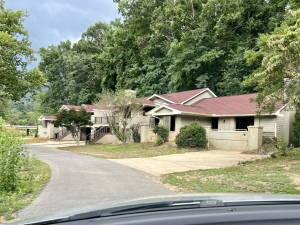
River Knoll community, July 2025

One year after Helene in Western North Carolina (WNC), homes are still in disrepair, roads are still on the “need to repair” list (including I-40), and friends and neighbors continue to seek to recreate “normal” in their lives. The devastation covered a land mass greater than the state of Connecticut. Visitors to our home still get a glimpse of the disaster in our area during the tours of Asheville and the WNC region.

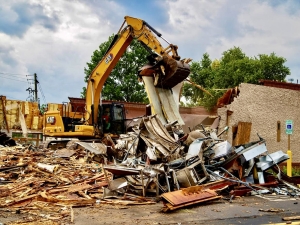
Demolition of the McDonald’s In the Biltmore Village, July 2025.

We had nearly 32″ of rain over three days, which led to 100-year flooding, resulting in 108 verified deaths as of June 17, 2025, over 2,000 landslides, over 400 road closings, over 100 bridges washed out, over 200 swift water rescues, 8.5 million cubic yards of debris, over 100,000 homes without water for 53 days, and power was out in some areas for weeks.

Tourism is vital to Asheville and WNC, and we certainly need it! Slowly, some businesses are coming back. Biltmore Village and the River Arts District are still recovering from the storm’s effects. Swanannoa, Burnsville, Chimney Rock, Marshall, Hot Springs, and other communities and towns in WNC appear to have a longer way to go in their recovery.

What did we learn from Helene in WNC?

Climate change is real, and the flood maps were way off! We are paying attention to other climate change events throughout our country and in the world. Seeing climate change on a screen is one thing; experiencing it is truly understanding its impact is another.

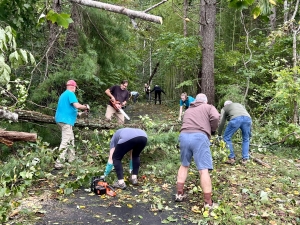
Neighbors helping neighbors, September 28, 2024

While individualism is a core American value rooted in our nation’s history, emphasizing personal freedom, self-reliance, and individual rights, commUNITY was essential in dealing with Helene’s aftermath. It became necessary to know our neighbors and their needs so that we could support one another, despite our differences in opinions and beliefs.

We had to embrace common knowledge, seek the truth, and reject and refute conspiracy theories, fake news, and false reports. Our local NPR station, Blue Ridge Public Radio* (BPR), became a lifeline. It was the news source we could trust and rely on. Their on-the-ground reporters gave us up-to-date news. They carried the twice-a-day live news updates from the City of Asheville and the Water Resources Department, Buncombe County, law enforcement, health services, and Duke Power

We learned to challenge assumptions. Living in the mountains does not mean we are immune to hurricanes and tornadoes. We take water for granted and fail to recognize how much it is a part of our daily lives!

We learned that the role of diversity, equity, inclusion, and belonging was essential in support and healing. Some of us possessed unique gifts, talents, and passions that contributed to our recovery. Some of us had tools to share that benefited the community. Some of us relied on others for essentials like water, ice, food, medication, and even a battery-powered light to turn on at night. Some of us needed a smile, a kind word, a voice of encouragement, a laugh, and a hug. We needed to remind each other that we were in this together and we would overcome this disaster and continue to do so.

We also learned the importance of the Boy Scout motto, Be Prepared, and having essentials on hand, including cash, water, food, a battery-powered radio, blankets, a gas grill or stove, and a generator.

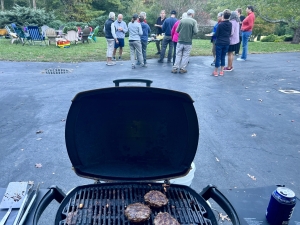
Daily gathering of neighbors for dinner, October 10, 2024

What did we lose from Helene in WNC?

Besides losing water (from handwashing, showers, washing dishes, and clothes), and power. We also lost many other things. Some of us lost everything, including family, friends, coworkers, pets, and livestock; all of us lost something. We lost innocence and safety. We lost routines like going to school, work, and going to the grocery store. We have lost confidence and hope in the systems that are supposed to help us, including those of politicians.

What are we grateful for from Helene in WNC?

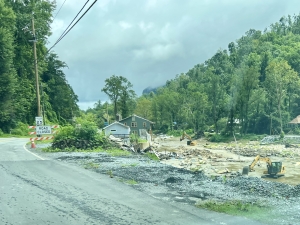
Chimney Rock – Broad River debris removal, August 11, 2025

We are grateful for heroes, such as first responders (locally and nationally), the Asheville Water Department staff (and all the support beyond WNC), Duke Power, and all the utilities from across the country that came to help restore power, as well as the tree services and debris removal services. We are grateful for the World Central Kitchen and faith-based organizations that provided us with hot meals when we couldn’t prepare them for ourselves. We are grateful to our family and friends outside our community who continually reach out to check on how we are doing and ask how they can assist us. We are thankful for our neighbors. Our relationships have deepened. We recognize the gift of connection and feel blessed! We love and appreciate Asheville and WNC more than ever!

Please visit and support WNC as we continue to rebuild.

I wrote several blogs back in late 2024 about our experience with Helene.

Are You Ready For Disaster?

What Is A Typical Day Like Without Power, Internet, or Water?

I Need to Say “Thank You!”

Four Reasons NOT to Come to Asheville, NC, Right Now

Background on My Last Blog…

* Blue Ridge Public Radio lost $330,000 in funding with the termination of the Corporation for Public Broadcasting. Please support BPR and your local NPR radio stations with a sustaining monthly gift. Any and every contribution helps to maintain this vital source of news and information throughout our country.

I Got Goosed!

I attended my first Wild Goose Festival (also known as The Goose) in 2014, in Hot Springs, NC. The Goose delivers on six commitments: Co-Creation, Storytelling, Radical Hospitality, Real Relationships, Non-Violence, and Always Evolving. Goose participants include social justice advocates, misfits, mystics, prophets, sages, storytellers, and seekers—this is where you experience the disconnect of spirituality with certainty. The Goose is a safe space for connecting, learning, pondering, and transforming. The Goose is where I got introduced to Reverend William Barber II, Tripp Fuller, Brian McLaren, Sara Miles, Jim Wallis, and Lisa Anderson. There was music from David Lamotte, Lyric, and Jars of Clay, among others.

The primary outcome of attending the Goose was a call for action! I knew I needed to return in 2015. The highlight for me at the 2015 Goose was Bree Newsom Bass, who climbed the South Carolina State Capitol flagpole to remove the Confederate Flag! This festival was about peacemaking in a time of Black Lives Matter, following the murder of Michael Brown in Ferguson, MO, in August of 2014.

I kept returning to the Goose until it moved from Hot Springs, NC, to VanHoy Farms & Campground in Union Grove, NC, in 2022.

I returned to the Goose this year. Once again, a great experience, but I missed sitting in the French Broad River, cooling off, and getting re-baptized in nature. I missed the giant old-growth trees that shaded the Goose participants in Hot Springs. Change makes you realize what you take for granted and expect.

The map of the 2025 Goose

There were tents set up for speakers, presenters, panel discussions, music, art, cinema, yoga, book sellers, and conversations. Even the United Methodist Church and Episcopalians had tents!

Some speakers shared their Holy Spirit moments of recognizing that LGBTQ+ people are not sinners and their love for a person of the same sex was not a sin. There were others like Aaron Davis, who spoke on From Guns to Trees, a former NRA fundraiser, who realized after listening to Reverend William Barber II at the 2015 Goose that he and the NRA were oppressors. They were not leaving the world a better place for tomorrow’s child.

Sarah McCammon and Ray Waters, Beyond Belief: Navigating Post-Evangelical Faith, shared their transformations away from conservative evangelical “truth.” Why would God give “truth” to a small group of people who practiced exclusivity? They pointed out the danger of the moral majority (which is neither moral nor a majority) of fusing the evangelical church with politics. It’s mean-spirited.

John Pavlovitz – The Christian Left and the Christians Who Left

John Pavlovitz, The Christian Left and the Christians Who Left, shared that he is having a hard time being a Christian today. He asked, “What can we learn from MAGA Christianity?” After all, caring for the least of these is not part of the American Dream. He calls for seeking to be partners, not owners, and to fight kingdom building like Jesus did. He challenged participants to know their community, go to the gap they see, and act upon it. Make all people feel visible as Jesus did.

Mike Maeshiro pointed out that Jesus made it clear that radical redemptive love doesn’t have room for an eye-for-an-eye. He suggested looking in the mirror and asking yourself if you are entitled to hurt others. Maeshiro reminded us to stay hopeful with Unitarian Minister Theodore Parker’s words, “The arc of the moral universe is long, but it bends toward justice.”

Lisa Sharon Harper, Robb Ryerse, Rev Dr. Perzavia Praylow, and Robb Schenck discuss Christian Nationalism

The panel discussion with Lisa Sharon Harper, Robb Ryerse, Rev Dr. Perzavia Praylow, and Robb Schenck on Christian Nationalism was informative and concerning. The number one concern among conservative evangelicals today is transgender people. Love is not what it says; love is what it does. Do not confuse white Christian Nationalism with holiness. Christian Nationalism is a new form of the Crusades. The words of Dietrich Bonhoeffer still hold, “The Church is the church only when it exists for others…not dominating, but helping and serving. It must tell men of every calling what it means to live for Christ, to exist for others.” They suggested that what needs to happen in the church begins by following the lead of women – white guys need to be quiet! Get transformed!

Gee Bree, Dividing Bone and Marrow – an exercise in differentiating between sexual and romantic attraction, and other lessons from Ace Theology, facilitated an enlightening conversation on asexuality and helped us understand sexual and romantic attraction, including what the church has taught. I have more to learn from her facilitation!

Grace Ji-Sum Kim, “When God Became White”

My last Goose experience was with Grace Ji-Sun Kim, a Presbyterian professor of theology at the Earlham School of Religion, who spoke about her book, “When God Became White.” She began by stating, “Everything is connected to race. Race influences how we act and behave daily.” Kim shared that she was an Asian immigrant girl who grew up with a white Jesus. Warner Sallman’s painting, The Head of Christ, hung on the family’s living room wall to continuously reinforce that Christ was white and so was God. The Church was and continues to be a significant source of racism and sexism in the world today. As a result, how we know God is how we behave. How we treat others determines our racism. Before there were Black/White labels, people were differentiated by Christian and non-Christian.

The truth is, Jesus was not white, but you can’t have a savior who does not look like you! The Church needs to stop becoming like white people. How are we going to move away from a white male God? Kim suggested we begin by seeing God as a verb – see God as active and as wisdom. Like the warning label on cigarette packages, the Bible needs a warning label. Getting rid of racism and sexism is at the heart of the Bible. We need EVERYONE at the table!

My 2025 Goose experience still lingers as I ponder, think, and reflect on who I saw and heard. I am moved to act upon what I learned and experienced.

Go forth into the world in peace.
Be of good courage.
Hold fast that which is good.
Render to no one evil for evil.
Strengthen the fainthearted.
Support the weak.
Help the afflicted.
Show love to everyone.
Love and serve the Lord,
rejoicing in the power of the Holy Spirit;
and the blessing of almighty God,
the Father, the + Son, and the Holy Spirit,
be among you and remain with you always. Amen.

Join me at the 2026 Wild Goose Festival, September 3-6. For more information, including ticket details, visit wildgoosefestival.org.


How Do You Relieve Stress?

In a recent coaching session, we discussed stress and strategies for managing it. The client mentioned she was practicing meditation, yoga, and deep breathing.

I acknowledged that all those practices are beneficial. I also pointed out that these activities are focused on herself and turning inward. I asked her what she was doing to help or serve others, turning outward.

She asked me to share more. I learned early on that people are either givers or grabbers. Givers seem to be the happiest and least stressed among us.

I shared that I’ve always found the best stress reliever to be helping and serving those in need. When we look out for others, it takes our focus away from us and on others. We are less likely to compare ourselves to others; in fact, we tend to look at those in need as a catalyst for recognizing the blessings we have and to be grateful. Endorphins and dopamine kick in!

Throughout my life, my work has always been about serving and helping others. Instead of doing what I love, I found that I loved what I did – making a difference in others’ lives.

Are You Lazy When It Comes To Trust?

Years ago, I facilitated a simple trust-building initiative for a large group, which opened a conversation on trust. Participants mingled, stopped, looked into another person’s eyes, and said either “I trust you” or “I don’t trust you.” There was no explanation of why they said what they said. They just moved on after their statement to someone else. After a couple of minutes, I asked people to stop and gather in a circle.

During the debrief, many participants expressed discomfort with the exercise. They reported feeling a range of emotions from shame and disappointment to anger and resentment. The debrief revealed a need to know and the risk of stepping into uncertainty.

How would you feel if someone walked up to you and said, “I don’t trust you.”? In today’s toxic, untrusting culture, a common response might be, “That’s your problem, not mine.”

I began the June 29th blog “Are You Lazy When It Comes to Critical Thinking?” acknowledging that the United States has indeed experienced a recent surge in productivity, driven by a combination of factors that have contributed to the rise in output per worker. I believe we have an epidemic of laziness.

I believe we have an epidemic of laziness in trusting others, trusting processes, and trusting visions.

Are you lazy when it comes to building bridges of trust? These questions require critical thinking and may give you clues:

  • Is trust hardwired in us? Is trust natural?
  • Trust is highly subjective and contextual. Does trust matter anymore, or is trust more important than ever?
  • If you believe trust is vital, how do you prevent trust stagnation?
  • Some say trust is a psychological state in which you express a willingness to be vulnerable. Do you have to be vulnerable to trust, or do you have to trust to be vulnerable?
  • Is trust the conduit for dealing with the unknown, such as taking a vaccine, riding in a self-driving car, asking AI to make a decision for us, or walking onto a frozen pond?
  • Is trust a process of intention, expectation, and behavior? Is trust a state of being? What are the benefits of trust?
  • Are you trustworthy? What is your evidence?

Trust is the bridge between the known and unknown. Trust is a confident relationship with the unknown. At the heart of trust is placing our faith in someone or something, believing it is safe to take a risk. – Rachel Botsman

Everything begins with trust! According to child psychologist Erik Erikson, our exposure to trust begins with our parents and caregivers. Parents and caregivers play a crucial role in shaping their child’s perception and future relationships. Trust is built on affection, comfort, and feeding. Quick and consistent response to these three needs builds trust. Parents who exhibit inconsistent, unreliable, and unpredictable behaviors can lead to a lack of trust and confidence in their children. I believe that our early experiences with how our parents and caregivers treated us lay the foundation for the principles and core values we hold ourselves accountable for living by.

Global authority on trust, Rachel Botsman, says that while money is the currency of transactions, trust is the currency of interactions. Trust is highly subjective and contextual. We are being asked to take more “trust leaps” than ever before.

In relationships, trust isn’t a promise to never hurt each other. It’s the risk that we will hurt each other and the confidence that, if we do, we will come together to heal. Most importantly, trust requires taking risks together that help us grow into better partners for each other.- Esther Perel

Trust is created, built, and even regained when lost through transparency. Transparency is the key ingredient that makes the 12-Step Program work. The 12-Step Program serves as a guide for fostering better relationships and engaging in commUNITY. Participants must be transparent with one another. Transparency builds trust. Trust is at the heart of the 12-Step Program. 12-sep participants have to trust a higher power, a confidant, and finally the commUNITY. You do not have to be an alcoholic or addicted to something to learn, understand, and live the 12-Steps. If you want to explore the 12-Step Program, suggest reading Stephanie Covington’s A Woman’s Way Through the Twelve Steps or Dan Griffin’s A Man’s Way Through the Twelve Steps.

Are the leaders you are following in politics, business, or an organization transparent? What is your evidence? Do you trust them? Why or why not?

Are you transparent with others when you make a mistake and take responsibility for it? Are you transparent in admitting your limitations and seeking help? Are you transparent when you fail to keep a promise, apologize, and share how you will change that bad behavior? What habits do you need to change to build trust?


Are You Lazy When It Comes to Critical Thinking?

While it is true the United States has experienced a recent surge in productivity, driven by a combination of factors that have contributed to the rise in output per worker, I believe we have an epidemic of laziness.

I see and experience the epidemic of laziness in critical thinking.

“Critical thinking is the process of analyzing available facts, evidence, observations, and arguments to make sound conclusions or informed choices. It involves recognizing underlying assumptions, providing justifications for ideas and actions, evaluating these justifications through comparisons with varying perspectives, and assessing their rationality and potential consequences. The goal of critical thinking is to form a judgment through the application of rational, skeptical, and unbiased analyses and evaluation.” – Wikipedia

Jumping to conclusions, running people down, pushing conspiracy theories, and sidestepping research seem to be the primary forms of exercise in the United States these days. Fake, false, bogus, and phony information have become so normal that people are offended by truth, facts, and authentic, accurate information.

Daniel Kahneman, Thinking Fast and Slow, writes that 90% of our thinking is fast. While fast thinking can be a lifesaver and has its place in our daily lives, fake, false, bogus, and phony information thrives on fast thinking. Slow thinking requires time, effort, and more energy. Critical thinking is slow thinking. This short YouTube video clip explains the concepts of fast and slow thinking.

Are you curious? Curiosity is the critical tool of critical thinking. Curiosity leads to possibilities and stimulates our imagination, leading to creativity. Pessimism is devoid of critical thinking.  Science relies on critical thinking.

Having returned from my DePauw University 50th college reunion, President White emphasized that a key purpose and desired outcome of a DePauw education is to learn and embrace critical thinking. The studies I took at DePauw, which included anthropology, art, economics, English, foreign languages, history, music, philosophy, religion, and psychology (my major), have influenced my critical thinking and continue to do so today.

Have you engaged in critical thinking to discover your purpose and core values? Critical thinking is at the core of learning and living your life on purpose and in alignment with your core values. Know what you stand for and don’t stand for.

Critical thinking is acknowledging your flawed thinking in terms of bias and logical fallacies. Do you have confirmation bias, belief bias, self-serving bias, groupthink bias, or negativity bias? Do you have logical fallacies like ad hominem, tu quoque, loaded questions, appeal to authority, or black-or-white thinking? If you’re willing to explore your biases and logical fallacies, consider getting a deck of Critical Thinking Cards.

Critical thinking is an essential tool in coaching, counseling, and therapy.

Critical thinking is a vital cognitive process for individuals in leadership roles, including those in Scout troops, civic clubs, organizations, corporations, politics, and the POTUS.

Coaching, counseling, therapy, and leadership are founded on love! Love is a verb. The opposite of love is fear. Unlike fear, love requires critical thinking

Mel Robbins defines love as a combination of consideration and admiration. To consider someone is to be mindful and accepting of someone with all their warts, scars, and imperfections. It is a slow, conscious choice not to be controlling or trying to change someone. Consideration involves recognizing when and where someone needs you and your help, from something as simple as opening a door when their hands are full, to being with them during a challenging experience, and refraining from trying to fix or heal them. Admiration is about respect, approval, and wonder. This requires slow thinking, as it involves admiring people with whom you may disagree on beliefs and opinions, recognizing that you have more in common than you are uncommon.

Are you lazy when it comes to love? Are you lazy in loving your neighbor, your leadership followers, your teammates, members of your commUNITY who look different and believe differently? Are you lazy in loving yourself just as you are, with all your imperfections and failures?

My next blog will focus on the laziness of understanding, building, and maintaining trust.


Fifty Years Later… The Boulder Got Moved and So Did I!

Returned to my Alma Mater, DePauw University, for my 50th class reunion. As I walked past the infamous boulder at East College, I noticed it had been moved since my previous visit in 2015! This was a foreshadowing of other changes I would discover!

2015 DePauw University Boulder at East College

The Lows…

Remembering over 70 classmates who have died.

Meeting international students at my Delta Upsilon fraternity and learning about their concerns about ICE and deportations.

At the Saturday morning Convocation of Alumni, an opinion was shared that the one word that best described our class was apathy. Here we were, sitting in the beautiful Judson and Joyce Green Center for the Performing Arts, specifically in Kresge Auditorium. The lead benefactor of this $29 million facility was Joyce Green, a member of our class, and her late husband, Judson, Class of ’74. Their gift was one of empathy and compassion, stemming from their experience at DePauw and their desire for future DePauw students to have an incredible learning experience. In surveying some members of our class after the convocation, I heard better one-word summaries of our class: concern, uncertainty, change, and gratitude. A lot happened in 1975, including the end of the Vietnam War, the release of Jaws in theaters, the signing of the Helsinki Accords, the United Nations’ declaration of 1975 as International Women’s Year, the premiere of Saturday Night Live, and the first email being sent.

The highs…

It was great to connect with classmates and learn about their life journeys over the past 50 years. Lots of connections leading to a lot of smiles, “me, too,” and “WOW!”

One special highlight was sipping Old Pogue bourbon from Old Pogue Distillery.  Classmate Paul Pogue’s family revived its family’s distilling tradition, which had been shut down during Prohibition, dating back to 1876. The 5th and 6th generation Pogues created easy-sipping bourbon. Thank you, Paul Pogue! (The check is in the mail!)

Our class broke bread, sipped adult beverages, and connected at Bridges – Craft Pizza & Wine Bar rooftop on Friday evening, located off Greencastle Square. (Five stars!) It was there that I met classmate Holbrook Hankinson, PhD, Executive Director of the Center for Diversity and Inclusion at DePauw. As a white, heterosexual, privileged facilitator of diversity, equity, and inclusion, it was great to connect with Holbrook and visit the Center for Diversity and Inclusion. He gave me a tour! One of the many highlights of the tour was discovering a second-floor library filled with “banned” books.

When I graduated from DePauw University in 1975, it was primarily a white institution run by white males. While I do credit DePauw with challenging my critical thinking, it is a bold initiative today.

“We will be an institution where all students—regardless of background, identity, or ideology—who desire to learn with us are welcomed, supported, and have access to DePauw’s rich academic and social opportunities.”– DePauw Bold and Gold 2027 Strategic Plan.

The core values of DePauw University are:

  • Student Focus
  • Collaboration
  • Curiosity
  • Diversity
  • Inclusion

Today, DePauw University is led by President Dr. Lori S. White. She is a strong, bold, visionary! She shared during her breakfast remarks about a key question she was asked during her interview process. Could she learn to love DePauw? Her answer resonates not just in her one word, “YES!” but in her actions! Her leadership team is diverse, as are the faculty, staff, and students.

I am prouder of DePauw University today than I was 50 years ago! If I had an upcoming high school graduate or knew of one, I would encourage them to put DePauw University at the top of their college list.

To my ’75 DePauw classmates, if you are coming to Asheville, NC, please reach out and let’s connect! We love sharing our guest bedroom!


What If There Were a Project 2026?

Liz Cheney challenges Democrats with A Remarkable Message.

As a registered independent voter, I pay attention to both parties in the news, podcasts, and streaming.

It is obvious the Democratic Party is a “ship without a rudder.” If the Democrats want my opinion, they need to create Project 2026 – clearly state who they represent, stand for, and don’t stand for, plans of action for creating a better world for tomorrow’s child, and save the United States and Planet Earth from destruction.

Project 2026 needs to commit to compassion for the most vulnerable among us and demand inclusivity. It needs to challenge elected officials to represent constituents and not corporations, oligarchs, and the wealthy.

Project 2026 needs to recognize our past ugly behavior and history, and demonstrate the need for change, including how to overcome white-male-heterosexual-Christian Nationalism. Turn shame into a promise to be better.

Project 2026 needs to draw inspiration from John F. Kennedy’s 1961 challenge to put a person on the moon by 1969. It needs to rally us to find common ground and commUNITY we experienced after 9/11. I want democracy and accountability, as outlined in the U.S. Constitution, to be a reason to get up in the morning and work towards.  It needs to be based on love, giving hope rather than fear, and individualism.

Tuesday, June 24, 2025, NYC Democratic Primary shows a crack in the stodgy-old-white-man-elitist mentality plaguing the Democrats. It’s a start!

After attending and reflecting on an address to my DePauw 50th Class Reunion, I have concluded that if I could summarize in one word the description of the United States today, it would be lazy.

I am going to write a blog series, Are You Lazy? beginning with Are You Lazy at Critical Thinking?

I welcome your thoughts, suggestions, and ideas.


NOTE: Someone emailed me, “I love this idea! Where do we start?”

Let’s begin just as they did with Project 2025, in collaboration with the Heritage Foundation. We identify think tanks, such as the Brookings Institution, the Roosevelt Institute, and the Institute for Policy Studies, and reach out to them. Perhaps we start a letter, email, or phone call campaign!?

What If We All Practiced Kintsugi?

The story of kintsugi (golden repair)—this style of pottery—may be the most perfect embodiment of all our trauma-shattered lives… Instead of throwing away the broken beloved pottery, we’ll fix it in a way that doesn’t pretend it hasn’t been broken but honors the breaking—and more so, the surviving—by highlighting those repaired seams with gold lacquer. Now the object is functional once again and dignified, not discarded. It’s stronger and even more valuable because of its reinforced, golden scars.                                                                                                                                                     – Jay Wolf, Suffer Strong

We all get broken in some way in our lives. Brokenness is part of the human experience. Vienna Pharaon, in The Origins of You: How Breaking Family Patterns Can Liberate the Way We Live and Love, writes about the five origin wounds: worthless wound, belonging wound, prioritization wound, trust wound, and safety wound. (Take the quiz to discover your origin wound.) Understanding your wound and managing your wound reveals a pattern, perhaps a habit, and your relation to that wound.

We can choose how to handle our wounds and brokenness. Pretending the brokenness is not there is unhealthy. It feeds our shadow self.

I experienced a lot of grief and brokenness after Hurricane Helene devastated Western North Carolina and our 2024 political election. I found an article about how practicing Kintsugi was a pathway to healing, and started practicing it. I get Kintsugi pieces from the Asheville Habitat ReStore.

The Kintsugi practice has retaught me patience, mindfulness, focus, pondering, and wonder! It has reminded me to stay curious. It has also given me joy and hope. Kintsugi is about embracing our healing and finding the “gold” in our wounds and brokenness so that we can use that “gold” to aid the healing of the world around us.

Kintsugii has also made me aware of the shadow self – the repressed things about myself that I do not want others to perceive. By protecting a chosen persona, we create a life of delusion. Kintsugi invites breaking open the shadow self. You have to become vulnerable and humble.

The world breaks everyone, then some become strong at the broken places.  ~Ernest Hemingway

A couple of things I practice in the ritual of breaking and repairing a piece of pottery…

I look at the piece of pottery and try to imagine the shadow self – how it was made and by whom. Why was it made? Who purchased it? Why? What did they use the piece for? How long did they own it? Was it passed down to others? How many hands touched this piece of pottery? Did the pottery bring joy? Did it have a special meaning? Why was it donated to Asheville Habitat ReStore?

Before I break it, I bless the piece: “Let the actions of my hands, mind, and heart be acceptable, help heal the wound I am about to inflict, and find the beauty in the broken.”

As I am repairing, I think about what I need to do to heal my wounds, fix my brokenness, and reflect on the worthiness of brokenness. How is my shadow self revealing itself to me? Like the scars and tattoos on our bodies, our wounds and brokenness are treasure maps of stories of our lives. Our wounds and brokenness offer strength and wisdom to become better versions of ourselves.

After the piece is finished, I hold it in gratitude and think about whom I can give it to! I’ve probably broken, repaired, and given away over 50 pieces, and I have about a dozen pieces to break and repair at my table!

What if we find the “gold” in our wounds and brokenness and use that “gold” to aid the healing of the world around us? What if we treated one another, especially those we disagree with, whose opinions and beliefs differ from ours, like pieces of kintsugi, broken, but worthy? What if we helped one another to repair each other’s brokenness by being there for one another, suspending judgment, and being curious?

I challenge you to examine your brokenness. Find your worthiness in your brokenness and use it to help others with their brokenness. Become fully functional once again and dignified, not discarded. Becomes more substantial and more valuable because of your reinforced golden scars.


DePauw University 50th Class Reunion Reflections

I volunteer at the Asheville, NC, Habitat Restore. I was working the cash register recently, and a woman checking out remarked about my wedding band. She said, “That is an unusual design!” I told her I designed this and my wife’s wedding bands in lost wax 45 years ago.

I learned lost wax jewelry design from DePauw University Art professor Bing Davis during the winter term 1972. This experience made me think about returning to DePauw this June 2025 for my 50th college reunion.

DePauw University had a significant impact on my life.

Some professors challenged my thinking, my beliefs, and my values. Anthropology professor Robert Fornaro taught me critical thinking. Psychology professor Harry Hawkins challenged me to examine my childhood and how it shaped me. Econ professor Ralph Gray taught me the economics of crime! Music professor John Sox opened my eyes and ears to opera! Religion professor Robert Eccles introduced me to my core values of compassion, justice, and humility, which I still hold myself accountable to, and one of my tattoos! I spent a week in the infirmary during my freshman year under the care of Dr. Roger Roof, who was treating me for mono! My first computer interaction was in 1974 at the Computer Center.

I recall Margaret Mead, Abby Hoffman, William F. Buckley, and Tina Turner coming to DePauw and listening to them.

DePauw is where I learned to live in a community with 60 other men who shared common space, showers, meals, and beer! Delta Upsilon fraternity brothers still call me by my nickname, “Austin,” given to me the first day I moved in after rush.

I fell in love at DePauw, and while it didn’t last, it taught me a lot more about myself so that I could be in a committed relationship.

I remember a significant conversation while walking with Bob Geising just before our graduation, who pointed out that we had been solving the world’s problems for the past four years, and we were about to graduate and start solving our problems! I am now trying to do both!

I am at the point in my life where I have become mindful that this may be the last time I experience something or someone, including returning to the DePauw campus. I look forward to returning to DePauw and thinking, “Remember when…”